AI’s Trillion-Dollar Buildout
Published September 2026
- AI is driving a global infrastructure investment wave projected to exceed $1 trillion in 2026, including nearly $600 billion in the US
- Data-center construction is supporting economic growth and spreading demand from semiconductors into industrial equipment
- The buildout faces constraints with power generation equipment, labor, and local government permitting
Artificial intelligence has moved beyond software and into the physical economy. The most visible evidence is the rapid construction of data centers packed with advanced chips, networking equipment, and cooling systems. Goldman Sachs estimates global AI investment will exceed $1 trillion in 2026, including $581 billion in the U.S. That scale places the current wave within the range of past general-purpose technology buildouts and makes AI spending large enough to influence economic growth, corporate financing, and financial markets.
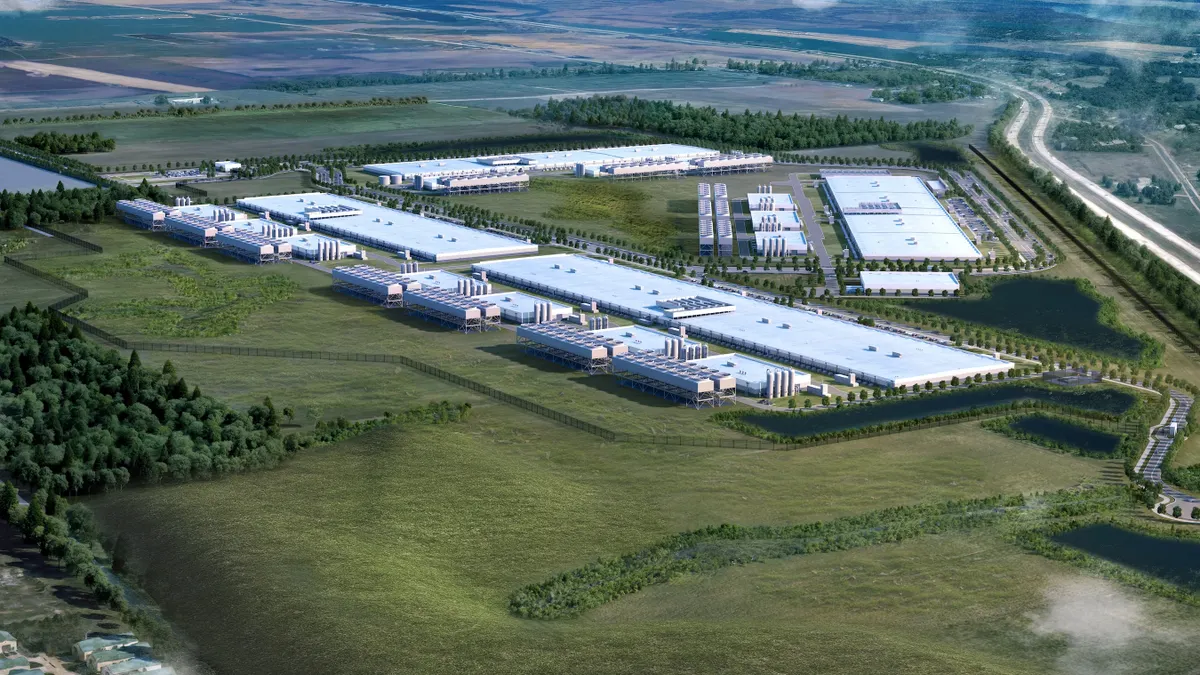
Data centers provide the computing power used to train AI models and respond to user requests. Their owners include the largest cloud companies, often called hyperscalers, such as Amazon.com (AMZN), Microsoft (MSFT), and Alphabet (GOOGL). The buildings are only the shell. The larger expense lies inside, where specialized processors, memory, high-speed connections, backup generators, and liquid-cooling systems operate around the clock. As AI models become larger and more widely used, operators must add computing capacity while upgrading the power and cooling infrastructure needed to support it. Wells Fargo estimates about 40 mega data centers are under construction and more than 100 are planned, concentrated in states including Texas, Georgia, Virginia, and Pennsylvania.
The investment is already visible in U.S. economic data. Annualized construction spending on data centers reached $68.3 billion in June, up $21.5 billion from a year earlier, even as spending on other private construction declined. J.P. Morgan estimates a proxy for AI-related investment contributed 0.47 percentage points to the 2.1% pace of real U.S. economic growth over the past year after accounting for imported hardware. The precise contribution is difficult to measure, but the direction is clear: without the AI buildout, the economy would be growing more slowly.
The effect reaches well beyond technology companies. Each data center requires electrical equipment, turbines, heating and cooling systems, engineering services, skilled construction labor, and large amounts of energy. This demand is changing the growth profile of industrial companies that historically relied more on cost control and modest economic growth. Equipment sales can also create years of higher-margin service revenue through maintenance, replacement parts, and system upgrades.
Financing the expansion is becoming a market of its own. According to FactSet estimates, capital spending by Alphabet, Amazon, Meta Platforms (META), Microsoft, and Oracle (ORCL) could approach $4 trillion during the four years ending in 2029. Companies are tapping bonds, equity, private capital, and project-level financing to fund those plans. Nvidia (NVDA) has partnered with Apollo, Blackstone, BlackRock, Brookfield Asset Management, Goldman Sachs, and KKR to establish compute-financing platforms. The firms aim to mobilize more than $500 billion of outside capital in the coming years, giving Nvidia customers access to financing for scarce computing capacity and the infrastructure required to operate it.
“Goldman Sachs estimates global AI investment will exceed $1 trillion in 2026, including $581 billion in the US.”
Demand indicators help explain why spending plans continue to rise. CFRA reported that the combined backlog among major cloud providers and newer cloud specialists exceeded $2.5 trillion in the second quarter, up from about $750 billion three quarters earlier. The figure represents contracted cloud revenue commitments that have not yet been recognized, including multiyear agreements for AI computing services and infrastructure. These commitments provide revenue visibility and encourage suppliers to add capacity, although a meaningful share is tied to a small number of large AI customers. At the same time, the commitments spread the AI theme beyond the technology sector into electrical gear, optical networking, power generation, data-center real estate, and specialized cooling. The market opportunity is broadening, but so is the economy’s exposure to continued AI demand.
Physical constraints may determine how quickly announced projects become operating assets. Utilities need years to add transmission and generation, while shortages of electricians, welders, and other skilled workers can delay construction.
Some operators are developing power directly at data center sites because grid connections are unavailable or too slow. Projects also face local opposition over electricity prices and community disruption. These bottlenecks can raise costs, push completion dates back, and limit how much planned capacity is delivered on schedule.
The central financial question is whether usage and revenue will catch up with the investment. Cloud growth and expanding backlogs offer early evidence of monetization, but the largest operators are committing capital faster than revenue is growing. Higher depreciation, financing costs, and underused equipment could weaken returns if demand disappoints. AI may ultimately transform productivity and generate attractive profits, yet a useful technology can still experience periods of overinvestment. For the economy and markets, the buildout is already consequential. Its durability will depend on turning an unprecedented volume of concrete, electricity, and computing equipment into lasting cash flow.
by Dan Kupiec, CFA, Senior Investment Analyst and Anna Bulot, Investment Analyst at MainStreet Advisors.
Sources: Bloomberg, Morningstar, Wall Street Journal, CFRA Research
This report was prepared by Mainstreet Investment Advisors, LLC (“Mainstreet”), a federally registered investment adviser under the Investment Advisers Act of 1940. Registration as an investment adviser does not constitute an endorsement of Mainstreet by the SEC nor does it indicate that Mainstreet has attained a particular level of skill or ability. This is prepared for informational purposes only. The information herein was obtained from various sources. MainStreet Advisors does not guarantee the accuracy or completeness of information provided by third parties. The information in this report is given as of the date indicated and believed to be reliable. MainStreet assumes no obligation to update this information, or to advise on further developments relating to it. Opinions herein are as of the publication date and are subject to change without notice. This report may include “forward-looking statements” which may or may not be accurate over the long term. Report includes candid statements and observations regarding investment strategies, asset allocation, individual securities, and economic and market conditions. Statements, opinions or forecasts are not guaranteed. Do not place undue reliance on forward-looking statements. Actual results could differ materially from those described. This material is not intended to be used as a general guide to investing, or as a source of any specific investment recommendations, and makes no implied or express recommendations concerning the manner in which any client’s account should or would be handled, as appropriate investment strategies depend upon the client’s investment objectives. The material has been prepared or is distributed solely for information purposes and is not a solicitation or an offer to buy/sell any security or instrument or to participate in any trading strategy. The value of investments and the income derived from investments can go down as well as up. Future returns are not guaranteed, and a loss of principal may occur.
Sources: Bloomberg, Morningstar, Wall Street Journal, CFRA Research